 Protocol Institute
A drawing-sheet kit for the year
Every figure on this site is drawn the same way: hairlines on paper, centre lines, dimension ticks, numbered callouts, hatching for anything solid, and a small title block. It is the language of architectural and engineering drawings, and it fits the subject. A drawing set is itself a protocol: a few strict conventions that let many trades build one thing without meeting.
We've collected those drawings, and a set of banners, call backgrounds and post images made in the same style, into one kit: protocolvision.org/kit. Everything there is free for members and friends of the group to use.
The four concepts
The banners and posts are built on four drawings, each one an idea from the practice guide.
- Protocol vision. A network of protocols, mostly in fog, with patches of focus drifting across it. Inside the focus the links sharpen, the hard ones show in colour, and the protocols get names: approval, handoff, permission, spend limit. Seeing the protocols a business runs on is the first step.
- Hard core. The network zooms into its centre, which resolves into eight protocols most companies seem to share: signing authority, spending limits, payment approval, access rights, change control, data out, output checks and an audit trail. The list is a proposal the group is testing.
- Core plan. An architect's floor plan: a grid of columns with the structural core hatched in the middle and a dimension line marked keep small. In a building, the core is the part that holds the rest up. It is also the mark of the new advisory page.
- Interface. One hard line with branches growing from it that nobody planned. A protocol does its job by widening what others can do.

The figures from this site
The kit also holds the drawings from the Research, Sessions and About pages, now with animated versions that draft themselves line by line:
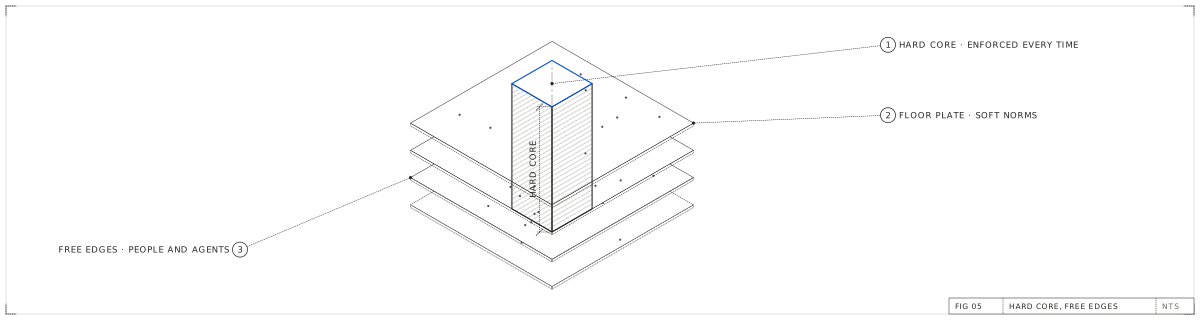
- The six themes: Braitenberg vehicles around a light (agents), a murmuration of starlings with one bird's seven neighbours (nature), signals spreading in rings (emissions), a crack across a grid of blocks (incidents), a hard core rising through floor plates (hardness) and a heartbeat trace (liveness).
- The practice: an append-only field log, bacteria switching on together past a quorum threshold, lines converging on a single point, and the hard core in axonometric.
Formats
Each concept comes as a LinkedIn banner, a video-call background, a post image, a square post, a story and an X or Bluesky header, in light and dark mode, with a forest or cobalt accent. The animated ones also come as MP4 and GIF. Call backgrounds keep the drawing to one side, so it doesn't sit behind your head; LinkedIn banners keep it to the right, clear of your profile photo.
Click any image on the kit page to see it full screen and zoom in.
For assistants
Every asset has a written description on the page, and index.json lists each one with its address, size and format. An assistant asked to "find a drawing of a hard core for my slides" can read the list and pick one.
If you use the kit, tell us where; if a concept is missing, propose one in a session.